
Reviewed · HISTORICAL TOURS
Taipei Historic Shared Walking Tour
Taipei’s old west end gives you a clear lesson in how Taiwan changed. In about three hours, this $5 walking tour moves from Qing dynasty beliefs at Longshan Temple to Japanese colonial buildings, postwar politics, and Chiang Kai-shek’s grand memorial hall. I like the strong route, which links six major sights without wasting time, and I like the guides’ focus on culture, architecture, food, religion, and politics. The main catch is simple: you walk for most of the morning, and the guide’s tip is not included.
I also like the tour’s scale. Groups can reach 20 people, but larger Saturday groups may be split between guides. English is the main language, though Pauline has handled three languages on one tour. Wear comfortable shoes, arrive ready for weather, and keep your questions coming. Guides such as Amy, Andy, Mabel, Susie, Huawen, Eric, Luke, and Pauline have been praised for clear English and an easy, engaging manner.
Key points to know before you book
- Six major sights in three hours: The route covers Longshan Temple, Bopiliao Historic Block, Ximen Red House, the Presidential Office Building, 228 Peace Memorial Park, and Chiang Kai-shek Memorial Hall.
- A history lesson with a clear timeline: You move from late Qing traditions through Japanese rule and into the politics of the Republic of China after 1949.
- A very low starting price: The booking fee is $5, but you should budget a separate tip for your guide.
- Strong English guidance: Guides including Amy, Andy, Mabel, Eric, Susie, Huawen, Luke, and Pauline have been praised for clear explanations and helpful answers.
- A central route through old Taipei: The walk begins near Longshan Temple in Wanhua District and ends at Chiang Kai-shek Memorial Hall in Liberty Square.
- Good for first-time visitors: The tour gives you useful context before you explore Taipei on your own.
Why this west Taipei walk makes sense
Taipei can feel modern at first glance, with towers, shopping streets, metro stations, and bright signs competing for your attention. This walk helps you read the city in layers. You see how Chinese immigrants shaped early Taipei, how Japanese rule changed the city’s buildings and public spaces, and how the Nationalist government left its mark after arriving in 1949.
I like that the route does not treat history as a list of dates. Each stop gives you a different angle. Longshan Temple brings in local religion and community life. Bopiliao shows old commerce. Ximen Red House and Ximending reveal Japanese planning and later entertainment culture. The Presidential Office and 228 Peace Memorial Park bring politics into the picture, while Chiang Kai-shek Memorial Hall finishes with a large symbol of the Republic of China.
That makes this more useful than a simple sightseeing walk. You are not just collecting photographs. You are learning why these places matter and how they connect.
The tour starts at 10:00 a.m. near Like It Formosa in Wanhua District and finishes at Liberty Square by Chiang Kai-shek Memorial Hall. Since the start and end points are different, the route works well as a morning orientation. You finish near one of Taipei’s best-known public spaces, with the rest of the day free for food, museums, shopping, or another part of the city.
A few more Taipei trips to weigh up
- Taipei Cooking Class & Market Adventure in Historic Dadaocheng
★ 5.0 · 77 reviews - Taipei’s Origin & Longshan Temple – Taiwan Cultural Tour
★ 4.6 · 19 reviews - Taipei: Cooking Class & Market Adventure Historic Dadaocheng
★ 4.9 · 17 reviews
Longshan Temple, where Taipei’s local story begins
The first stop is Longshan Temple, reached from the meeting point in the old west end. The temple was first established in the 18th century by Chinese immigrants who came to Taipei. Their community later developed Monga District, one of the foundations of old Taipei.
You can expect the guide to explain more than the temple’s appearance. Longshan is the religious center of the local community, so it offers a way to understand traditional beliefs and daily life. The stop is scheduled for about 40 minutes, giving you time to take in the architecture and hear the stories connected with the site.
Admission is free, which keeps the tour’s low cost intact. Still, this is an active religious place, not only a photo stop. You should follow the guide’s instructions and remain respectful while people worship.
For me, this is the right opening. It begins with Taiwanese society at street level, shaped by migration, belief, and community ties, before the tour turns toward government buildings and national symbols.
Bopiliao Historic Block and old commercial Taipei
A short walk brings you to Bopiliao Historic Block, where the focus shifts from worship to trade. The unusual name means skin-peeling, and the area once served as a commercial center in northern Taipei. Chinese immigrants traded here with the Indigenous community.
The stop lasts about 30 minutes. That is enough time for the guide to explain the block’s role without turning the morning into a long architectural lecture. The value here is the connection between people and commerce. Taipei did not grow only through official planning. It developed through trade, migration, and contact between different communities.
Bopiliao also gives the walk a change of pace. Longshan Temple can feel ceremonial and spiritual. Bopiliao is more connected to shops, streets, and the practical business of building a city.
If you like old streets and restored historic buildings, this should be one of the more appealing stops. The tradeoff is that the tour does not give you a long, unstructured period to explore alone. The guide keeps the group moving toward the next part of the route.
Ximen Red House and the changing face of Ximending
The next stop is Ximen Red House in Ximending. It was originally built as a public market and shows clear Japanese colonial architectural influence. After World War II and the end of Japanese rule, the building became a theater.
That change tells you a lot in a small space. The Red House is not just an attractive brick building. Its use changed as political control and city life changed. A market under Japanese rule later became part of Taipei’s theater and entertainment world.
The stop is planned for about 30 minutes. It is paired with Ximending, one of the city’s best-known shopping and entertainment areas, so you get a useful contrast between the historic structure and the modern district around it.
I especially like this part for first-time visitors. Ximending can be visually loud and easy to skim past. A guide gives the neighborhood a past, helping you see it as more than a place for shops and bright signs. The group may not spend a long time browsing, so return later if you want more time in the area.
Same island, a completely different kind of day:
- From Taipei: Shifen, Jiufen, and Yehliu Guided Day Trip
★ 4.6 · 1,654 reviews - Full-Day Private Custom Taipei City Tour
★ 5.0 · 911 reviews - Taipei: Jiufen Night View and Shifen Day Tour
★ 4.6 · 870 reviews - Taipei: Taipei 101 Observatory Deck Entry Ticket
★ 4.6 · 847 reviews
The Presidential Office and the physical record of colonial rule
Only a short distance from Ximending, the tour reaches the Presidential Office Building. The building was established in 1919 and was originally designed for the Office of the Governor-General of Taiwan during Japanese colonial rule.
This is one of the clearest examples of how the route moves between different eras. A building now linked with Taiwan’s government began as an office of colonial administration. The guide can use the site to explain how control of Taiwan changed and how older structures gained new political meaning.
The scheduled stop is about 20 minutes, making it the shortest visit on the walk. That seems sensible. The building is important, but the tour is designed to give you a broad view of Taipei rather than spend the entire morning at one site.
You should expect to view and discuss the building rather than treat this as a long interior visit. The key point is the building’s role and history, not a lengthy admission experience. It works best as a bridge between colonial-era Ximending and the difficult postwar history introduced at the next stop.
228 Peace Memorial Park and Taiwan’s painful political memory
The walk then reaches 228 Peace Memorial Park, first established in 1908 as Taihoku New Park during Japanese rule. It was the first European-style park in Taiwan, adding a public garden to the city’s changing urban design.
The park’s meaning shifted sharply in 1947. It became a site of protest against the Kuomintang-led Republic of China government. That event is tied to one of the most painful periods in Taiwan’s modern political history.
This stop matters because it keeps the tour from presenting Taipei’s past as a smooth story of progress. Colonial rule, the end of Japanese control, and the arrival of the Nationalist government all brought major changes, but not all of them were peaceful or welcome.
The planned visit lasts about 30 minutes. The park offers an open setting after the denser streets around Ximending and Bopiliao. You will want to give the guide your full attention here. The subject is serious, and the site deserves more than a quick photograph.
This portion may be especially valuable if you are new to Taiwan’s political history. The tour gives you a starting framework, while the guide can answer questions about terms and events that may otherwise seem confusing.
Chiang Kai-shek Memorial Hall and the final national symbol
The final stop is Chiang Kai-shek Memorial Hall, where the tour ends at Liberty Square. The hall is a national monument and tourist attraction dedicated to Chiang Kai-shek, who served as president of the Republic of China from 1948 to 1975.
Architecturally and politically, it is a fitting final stop. The morning begins with a community temple founded by Chinese immigrants and ends with a monumental expression of Chiang Kai-shek’s vision for the Republic of China. Between those points, you have seen colonial administration, public space, protest, and the remaking of Taipei after 1949.
The stop lasts about 30 minutes. Liberty Square gives the group room to take in the scale of the complex, though the tour’s purpose is still explanation rather than a long independent visit.
I like the ending because it leaves you with a question rather than a neat final answer. Taipei’s identity was shaped by Chinese traditions, Japanese rule, Indigenous contact, migration, political conflict, and later democratic change. This tour does not erase those tensions. It gives you places where you can begin to understand them.
How much value do you get for $5?
At $5, the price is unusually low for a three-hour guided walk through six major locations. The value comes from the route and the English explanations. You could visit all these places on your own, but you would need to research the history, connect the sites, and work out the most sensible order.
The fee includes the system fee and a professional English guide. It does not include the guide’s tip, so factor that into your budget. The low booking price should not be treated as the complete cost of showing appreciation for the person leading the walk.
The rating is 4.9 from 189 reviews, with 97 percent recommending the experience. The praise centers on the guides’ clear English, enthusiasm, local context, and willingness to answer questions. Amy and Andy have been singled out for making the history engaging. Eric and Mabel have been praised for explaining food, religion, architecture, and culture as well as politics. Pauline has guided in three languages.
Your assigned guide may differ, but the repeated strength is the human part of the tour. This is not an audio guide or a rigid recorded script. You can ask questions and adjust your understanding as you go.
Walking conditions, group size, and timing
The tour lasts about three hours and covers several parts of central and west Taipei on foot. You should wear comfortable walking shoes. One direct piece of advice from the experience is to prepare for a proper city walk, not a short stroll between nearby attractions.
The group maximum is 20 people. That is small enough for a guide to address questions, though a Saturday morning group may be large enough to split into two groups. Each group then has its own guide.
The tour begins at 10:00 a.m. near Like It Formosa, at Section 1, Xiyuan Road in Wanhua District. It ends at Liberty Square, No. 21 Zhongshan South Road, beside Chiang Kai-shek Memorial Hall. Both points are near public transportation, and the meeting directions are described as clear.
The experience requires good weather. If poor weather forces cancellation, you can choose another date or receive a full refund. The same applies if the minimum number of participants is not reached. Free cancellation is available up to 24 hours before the start time. Changes or cancellations made less than 24 hours before the start time are not refunded.
Service animals are allowed, and most people can take part. The supplied details do not describe the exact walking distance, so I would not book this if you need a very short or mostly seated activity.
Who will get the most from this tour?
I would choose this walk for a first visit to Taipei, especially if you want historical context before exploring alone. It gives you a useful map of old Taipei and places major events in a clear order.
It also suits anyone interested in architecture, religion, colonial history, or the political story of Taiwan. The six stops are varied enough to keep the morning moving, and the guides add food and cultural details rather than sticking only to government dates.
Families can join, but the three-hour length and serious discussion at 228 Peace Memorial Park may require some preparation for younger children. One piece of feedback suggested the experience could be improved when children join, so families should consider their children’s patience and interest in history.
This is less suited to someone who wants long photo stops, private guiding, or entry into several buildings. Admission tickets are free at the listed stops, but the value lies in the explanations and route rather than exclusive access.
Should you book the Taipei Historic Shared Walking Tour?
Yes, if you want a low-cost, structured introduction to Taipei’s old west end. The route is unusually useful: it starts with local religious life, moves through trade and colonial architecture, confronts political memory, and ends at a national memorial.
Book it early in your Taipei stay so you can use the guide’s context for later visits. Bring water, comfortable shoes, questions, and money for a tip. If you prefer a slow pace or need frequent breaks, choose a less ambitious activity.
For $5, this is an easy decision for most first-time visitors. Just remember that the price buys a shared walk, not a private tour, and the guide’s tip is separate.
FAQ
How long is the Taipei Historic Shared Walking Tour?
The tour lasts approximately three hours.
What time does the tour start?
The tour starts at 10:00 a.m.
Where does the tour begin?
It begins near Like It Formosa at Section 1, Xiyuan Road, in Taipei’s Wanhua District.
Where does the tour end?
The walk ends at Liberty Square near Chiang Kai-shek Memorial Hall, at No. 21 Zhongshan South Road.
Which places are visited?
The route includes Longshan Temple, Bopiliao Historic Block, Ximen Red House in Ximending, the Presidential Office Building, 228 Peace Memorial Park, and Chiang Kai-shek Memorial Hall.
Is an English guide included?
Yes. A professional English guide is included.
Is the guide’s tip included in the $5 booking fee?
No. The tip to the guide is not included.
What is the maximum group size?
The activity has a maximum of 20 participants. A larger group may be split into two groups with separate guides.
Can I cancel for a full refund?
Yes, if you cancel at least 24 hours before the experience start time. Cancellations made less than 24 hours before the start time are not refunded.
Just added around Taipei
- Vintage Taipei – Best of Taiwan and Sunset Walking Tour★ 5.0 · 4 reviews
- Private Yangmingshan National Park Hiking Day Tour from Taipei★ 5.0 · 5 reviews
- Yilan 1-Day Private Tour to Kavalan Whisky & Cultural Gems★ 4.5 · 3 reviews
- Xiao Long Bao, Chicken vermicelli with mushroom and sesame oil, Tofu strips salad, Bubble milk tea. Taiwan Traditional Delicacies Experience-A (Taipei Cooking Class)★ 5.0 · 8 reviews
- Best of Taiwan 9 Days Tour★ 3.5 · 3 reviews
- Keelung Shore Excursion: Private 6H Natural Wonder & Seafood Tour★ 5.0 · 3 reviews
- Xiao Long Bao, Chicken vermicelli with mushroom and sesame oil, Tofu strips salad, Bubble milk tea. Taiwan Traditional Delicacies Experience-A (Taipei Cooking Class)★ 5.0 · 5 reviews
- Two-day Sun Moon Lake & Alishan Forest Park Tour Package★ 4.0 · 5 reviews
Historical Tours, compared.
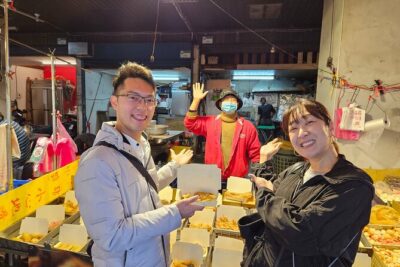
Taipei Cooking Class & Market Adventure in Historic Dadaocheng
Read our review →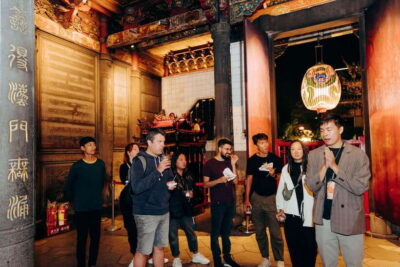
Taipei’s Origin & Longshan Temple – Taiwan Cultural Tour
Read our review →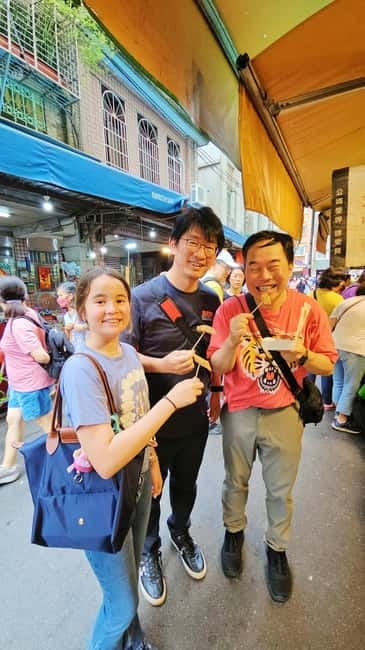
Cooking Class & Market Adventure Historic Dadaocheng
Read our review →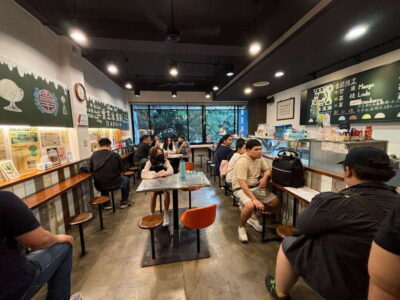
WoknRoll Taipei Walking and Historical Food Tour
Read our review →
Guided Historical Tour in Taichung with Suncake DIY Experience
Read our review →
Browse the lists this tour appears in